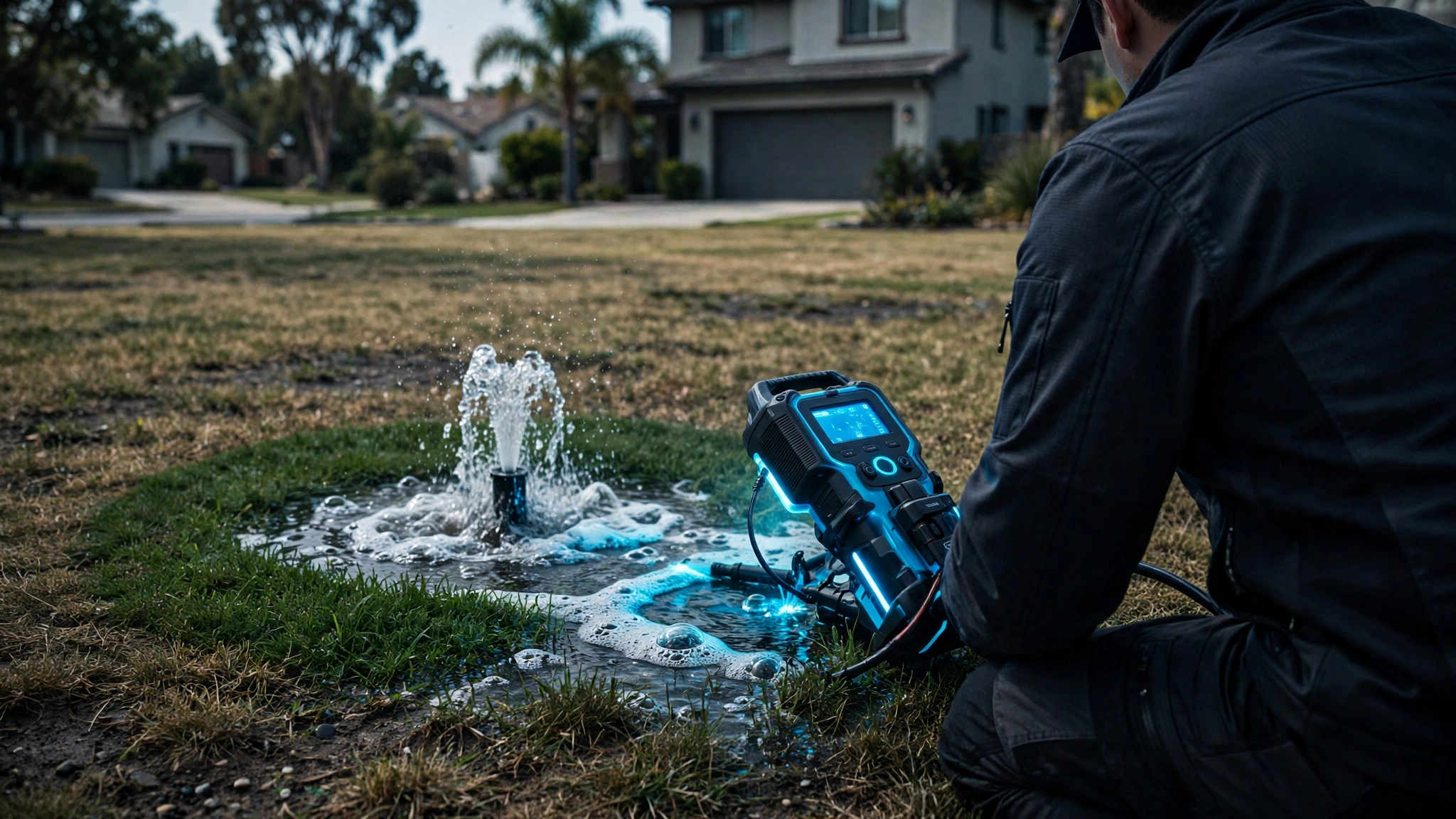
Camarillo loves its landscaping — and landscaping drinks water. When an irrigation line cracks, a valve sticks open, or a lateral line splits underground, the symptoms show up as soggy spots, mysteriously lush patches, a zone that barely sprays, or a water bill that climbs every month. Because irrigation runs on a schedule, these leaks can waste thousands of gallons between the times anyone looks closely. Irrigation Leak Detection is the diagnostic version of the job: we find the leak; your landscaper fixes it. Using zone-by-zone isolation and pressure testing — the same disciplined approach we bring to buried water lines — we identify which zone is losing water and pinpoint where along that zone the break is. No digging up the whole yard to find a cracked fitting. This is detection-only work, deliberately. Landscapers and irrigation contractors are the repair experts; we're the find-it experts. You get a marked location and a clear report to hand to whoever maintains your system.
Warning signs
When to call us
Call when a zone misbehaves, when soggy spots appear, when the meter runs with the controller off, or when your bill outpaces your watering. The best time is before the peak irrigation season — finding and fixing a leak in spring saves a summer of wasted water. And if your landscaper has already replaced heads and adjusted the controller without fixing it, the problem is underground: that's our territory.
How we find it
We work through the controller zone by zone, running each independently while watching flow. The zone whose behavior doesn't match its design — low pressure, short throw, unexpected flow — is the leaking one. Isolation turns a twelve-zone mystery into a single suspect zone.
With a zone isolated, we pressure-test its lateral piping. A line that won't hold pressure has a break; the rate of pressure loss even hints at the break's size. This is the same proven method used for buried water mains, applied to irrigation laterals.
Water escaping under pressure makes sound. Listening at valve boxes, heads, and along the lateral's path with a ground microphone converges on the leak's position — particularly effective for pressurized main lines that run constantly.
We read the meter with the whole system off, then with zones running individually. Comparing expected flow against actual flow quantifies the loss and confirms whether the leak is in the irrigation system at all — or somewhere else entirely.
On properties where nobody knows where valves or lines run, we electronically trace the irrigation piping to map the layout. You can't isolate what you can't find — tracing comes first, testing second.
Our process
- 1Controller and system review
We start at the controller: zones, run times, and what's been observed. Then a walk of the property noting wet areas, weak zones, and visible head problems. - 2Meter test with system off
With the controller fully off, we check the meter for continuous flow — establishing whether the irrigation system is losing water around the clock. - 3Isolate and pressure-test each zone
Zone by zone, we isolate and pressure-test the lateral lines, identifying which zone — and which section — won't hold pressure. - 4Pinpoint the break
Acoustic listening and electronic tracing converge on the leak's location along the confirmed-leaking lateral. - 5Mark and report for your landscaper
The location is marked on the surface and written up with our findings — a report your landscaper or irrigation contractor can dig on directly. We find it; they fix it.
Most residential irrigation investigations take one to two hours, depending on the number of zones and whether valve locations are known. You'll get the leaking zone identified, the break location marked, and a written summary for your landscaper. If the system checks out clean, we'll tell you — and suggest where else the water might be going.
Honest limitations
We're detection-only: we don't repair lines, replace valves, or rewire controllers — your landscaper or irrigation contractor handles that, and they're better at it. Valves buried without boxes, lines under mature tree roots, and systems with unknown layouts can slow the work; we'll tell you upfront what's accessible and what isn't. Some leaks only show under full operating pressure, so we may need the system running normally during the visit.
Camarillo & Ventura County context
Irrigation is a way of life in Camarillo — large residential lots, HOA common areas at communities like Village at the Park and Leisure Village, and commercial landscaping all run on scheduled watering with expensive imported water. The city council's four-year rate increases approved in May 2025 make every wasted gallon more costly. As a starting point, the city points residents to free indoor and outdoor water-use surveys through the Metropolitan Water District's bewaterwise program (see cityofcamarillo.org) — a good first check. When the survey flags a likely irrigation leak, or when you already know a zone is misbehaving, that's when diagnostic testing earns its keep. And while Camarillo's rare cold snaps seldom threaten buried lines, exposed backflow assemblies can crack in a hard freeze — worth a look each spring.