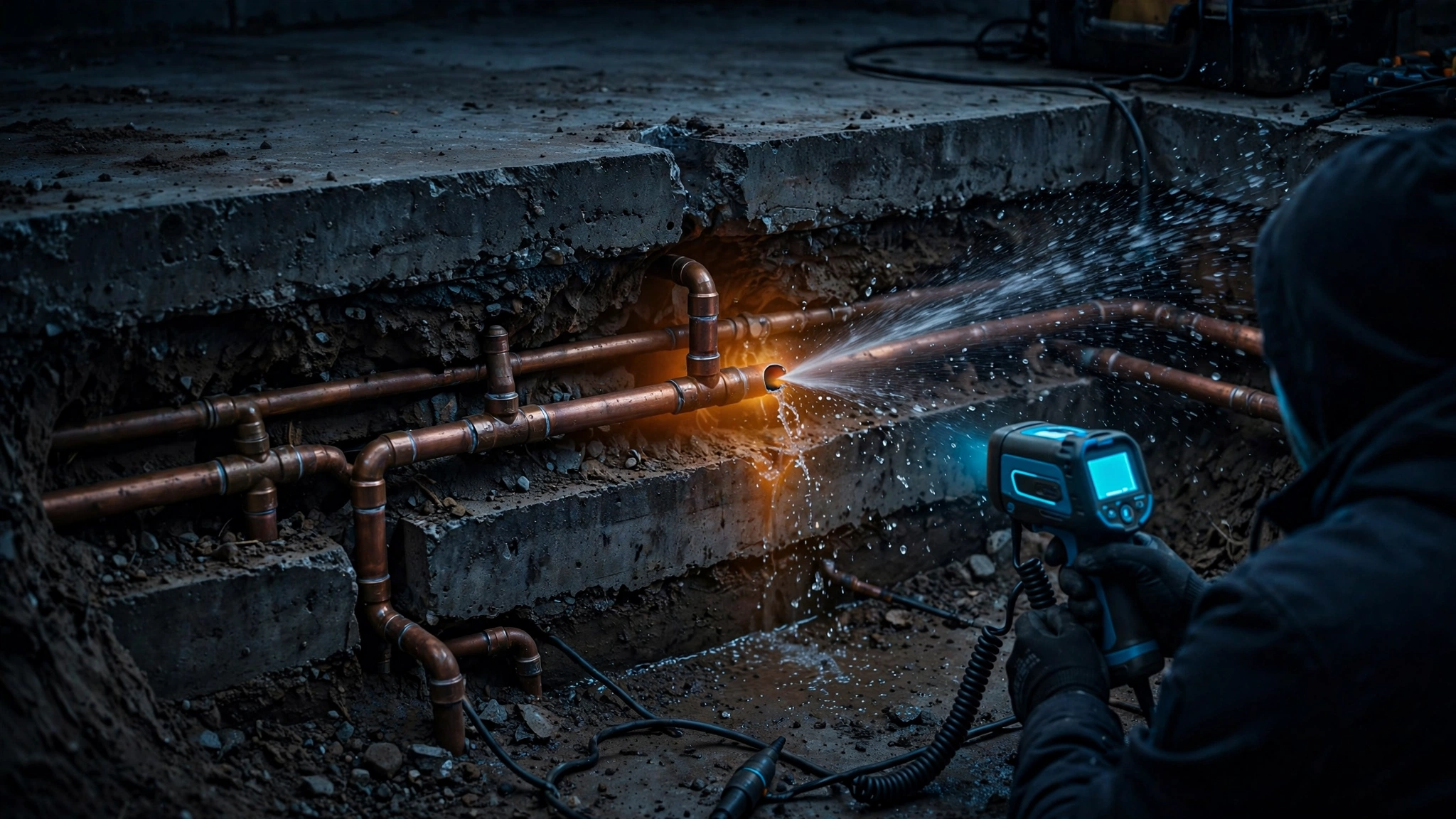
A slab leak is a water leak in the pipes running beneath your home's concrete foundation — and it is one of the most destructive hidden leaks a homeowner can face. Because the pipes are buried in or under concrete, the leak can run for weeks or months before it shows itself, quietly eroding soil, undermining the slab, feeding mold inside walls, and driving your water bill upward the entire time. Camarillo Leak Pros specializes in finding these leaks without tearing up your home first. We combine acoustic ground microphones, pressure testing and line isolation, electronic line tracing, and thermal imaging to narrow the leak to a marked spot on your floor — typically within a few feet, often within inches. That means your repair plumber opens concrete in one targeted place instead of chasing the leak across the slab. Much of Camarillo's housing stock was built from the 1950s through the 1980s with copper or galvanized supply lines run under the slab, and Ventura County's expansive clay soil swells and shrinks with the seasons, stressing those aging lines. If your water bill has jumped, your floor feels warm in spots, or you hear water running when everything is off, a slab investigation is the right next step — and we are available around the clock.
Warning signs
When to call us
Call for a slab leak investigation when you have two or more of the symptoms above, when your water meter moves with everything shut off, or when a plumber has told you a leak is 'probably under the slab' but cannot say where. The earlier a slab leak is located, the smaller the repair footprint — a precisely marked leak often means opening a few square feet of concrete instead of exploratory demolition across rooms.
How we find it
Pressurized water escaping a pipe creates a distinct high-frequency sound. We place sensitive ground microphones on the slab and compare readings across a grid, converging on the loudest point — the leak.
Before any listening begins, we verify a leak actually exists by pressure-testing the hot and cold lines separately. Isolating which line is losing pressure tells us which system to hunt in and rules out false alarms.
Using an electronic locator, we trace the buried pipe's path under the slab so we know exactly where the line runs. A leak can only be where the pipe is — mapping the route first keeps the search honest.
For hot-water slab leaks, an infrared camera can reveal the warm plume spreading through the concrete above the break. We use thermal as a confirming layer alongside acoustic readings, never as the sole evidence.
Pinless moisture meters and targeted readings at baseboards and flooring confirm whether water is migrating upward — corroborating what the acoustic and thermal equipment is telling us.
Our process
- 1Symptom review and meter check
We start by listening to what you have noticed and checking your water meter behavior with fixtures off, to confirm a pressurized leak is actually occurring. - 2Pressure test and isolate
Hot and cold lines are tested independently. Knowing which line leaks — and that the leak is real — focuses everything that follows. - 3Trace the pipe route
Electronic locating maps the buried line's path beneath your slab, so the search area is the pipe itself, not the whole floor. - 4Pinpoint with acoustic and thermal
Ground microphones sweep the pipe route while thermal imaging cross-checks for heat signatures. Converging readings mark the leak's position. - 5Mark, photograph, and document
We mark the spot on the surface, photograph the readings, and give you a written report your repair contractor can work from — targeted repair, not guesswork.
A slab leak visit is quiet, clean, and non-invasive — we do not cut concrete, pull up flooring, or open walls to find the leak. Most investigations take one to three hours depending on the home's layout and how many lines need testing. You will see us working with listening equipment on the floor, a thermal camera, and a locator wand; afterward you get a marked location and a written summary of findings you can hand to any repair plumber.
Honest limitations
Detection locates the leak; it does not repair it, and we will not tell you which repair method to choose — rerouting overhead versus breaking the slab is a decision for you and your licensed repair contractor, and each has trade-offs we will explain honestly. In rare cases a slab contains multiple leaks, or a leak sits where two lines cross and readings overlap; when that happens we say so plainly and document the ambiguity rather than guessing. Very slow weeps can also be harder to hear acoustically, in which case pressure-decay evidence carries the diagnosis.
Camarillo & Ventura County context
Camarillo's mid-century neighborhoods — from Old Town to the tracts around Mission Oaks and Camarillo Heights — are full of homes with original copper or galvanized lines under the slab, now fifty to seventy years into their service life. Ventura County's expansive clay soil adds seasonal movement that stresses pipe joints, and with imported water costs rising — the city council approved four years of water and sewer rate increases in May 2025 — an undetected slab leak now costs more every month it runs. That combination of aging under-slab plumbing and expensive water is exactly why precise, non-invasive slab leak detection matters here.