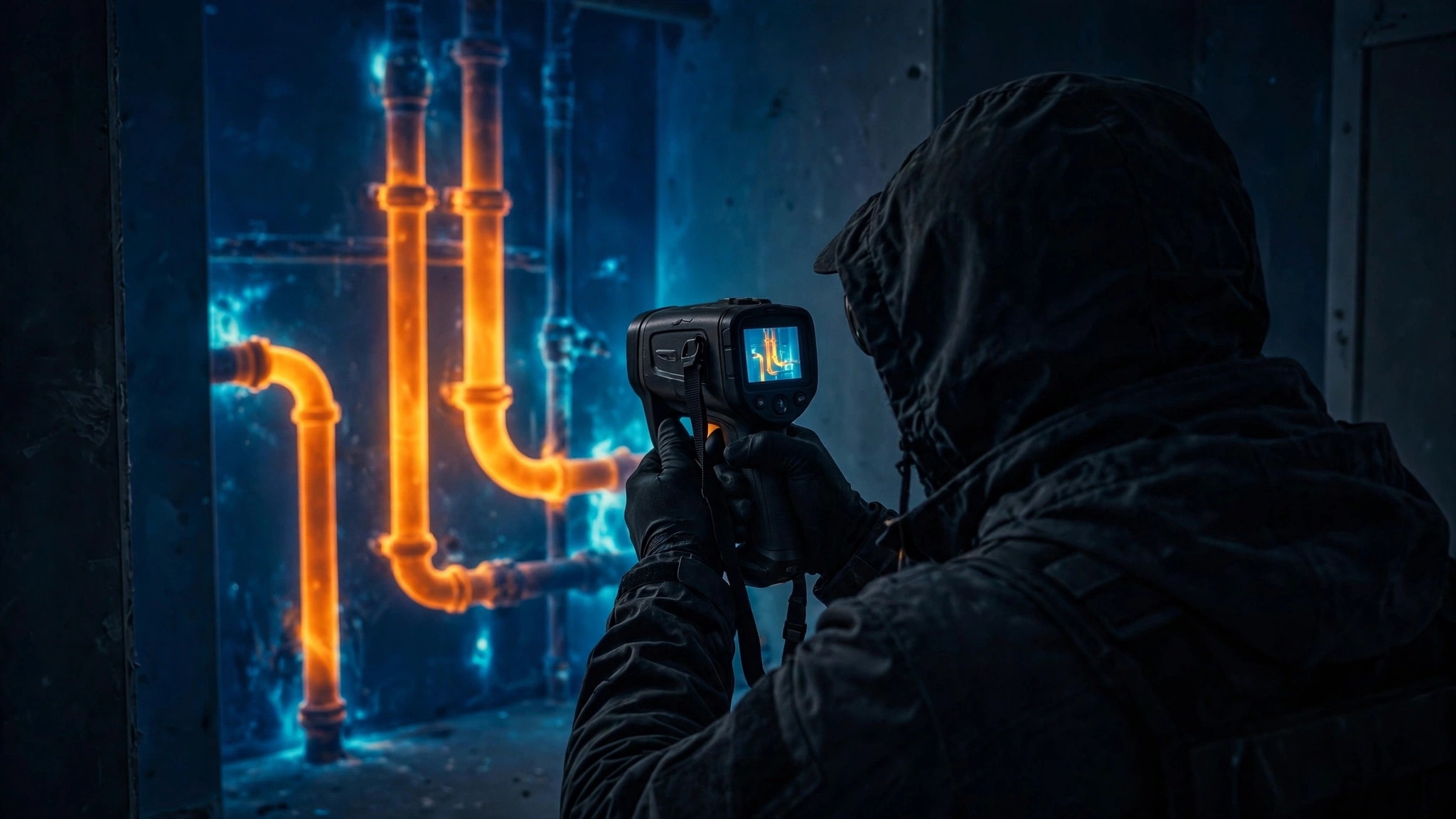
An infrared camera does not see water — it sees temperature. And because leaking water changes the temperature of the materials around it, a thermal camera can make a hidden leak visible: a hot-water slab leak paints a warm plume across the concrete above it; moisture evaporating inside a wall leaves a cool signature the camera reads clearly; a damp ceiling shows up as a dark, cool patch long before the stain breaks through the paint. Thermal imaging — also called infrared imaging or thermography — is one of the most powerful non-invasive tools in leak detection, and we use it across Camarillo on slab leaks, wall and ceiling investigations, and building moisture problems. But it is also one of the most misunderstood technologies in the trade, routinely oversold as a magic see-through-walls device. It is not. A thermal camera reads surface temperatures only, it needs a meaningful temperature difference to work with, and its images require trained interpretation — a cold spot can be missing insulation, an air leak, or thermal bridging, not just moisture. This page explains what thermal imaging genuinely does in leak detection, where it excels, how we use it alongside acoustic listening and moisture meters, and where its honest limits are. Understanding the tool is how you judge the quality of the diagnosis.
Warning signs
When to call us
Thermal imaging is appropriate whenever a leak is suspected behind or beneath a finished surface — slab, drywall, plaster, or ceiling — and a temperature difference exists or can be created. It excels on hot-water slab leaks, shower and tub surround leaks, and mapping moisture extent in walls and ceilings. It is less useful on cold-water leaks in temperature-stable environments, where acoustic listening or pressure testing should lead. We will tell you honestly which case yours is before we begin.
How we find it
A calibrated infrared camera captures thousands of temperature readings per second, rendering them as a color image where warm areas glow and cool areas darken. We scan systematically — floors, walls, ceilings — watching for the thermal signatures of moisture.
Thermal imaging needs a temperature difference to reveal anything. For hot-water leaks the difference is natural; for cold-water or ambient leaks we may run hot water through the system or use the building's own heating and cooling cycles to create contrast.
Every thermal anomaly gets checked with pinless and pin-type moisture meters. The camera shows where to look; the meter confirms whether moisture is actually present and how severe it is. A thermal image without meter verification is just a pretty picture.
On slab and wall investigations, thermal findings are correlated with acoustic listening. A warm plume directly above the loudest acoustic reading is a high-confidence diagnosis — two independent physics agreeing.
We compare suspect areas against known-dry reference areas in the same building, and photograph findings so you — and your insurer — can see exactly what we saw.
Our process
- 1Conditions assessment
We check ambient conditions first — recent HVAC cycling, sunlight on walls, and time of day all affect thermal contrast. The best scans happen when the building is thermally stable. - 2Systematic thermal scan
Floors, walls, and ceilings in the suspect area are scanned slowly and methodically, with anomalies noted and re-scanned from multiple angles. - 3Moisture meter verification
Each thermal anomaly is probed with moisture meters to confirm actual moisture content and rule out insulation gaps, air leaks, and thermal bridging. - 4Acoustic cross-check where applicable
For pressurized-line suspects, acoustic listening confirms whether the thermal anomaly sits over an active leak. - 5Documented thermal report
Findings are delivered as a written report with thermal images, meter readings, and marked locations — documentation your repair contractor and insurance adjuster can use.
A thermal imaging survey is quick, silent, and completely non-contact — the camera never touches your walls. We will ask that HVAC has been off or stable for a while before we arrive and may run hot water to create thermal contrast. You will see real-time thermal images on the camera's screen, and we will walk you through what each pattern means as we go. Most thermal surveys take under an hour as part of a larger investigation.
Honest limitations
Thermal imaging reads surface temperatures — it cannot see through walls, concrete, or any other material, despite what some marketing suggests. It needs a temperature difference of several degrees to reveal moisture; a cold-water leak in a climate-controlled house on a mild day may be thermally invisible. Reflective surfaces like stainless steel and glass confuse the camera, and not every cold spot is moisture — missing insulation, air infiltration, and thermal bridging all create similar signatures, which is why meter verification is mandatory in our process. Thermal is a superb mapping and confirming tool; it is rarely sufficient as the only evidence.
Camarillo & Ventura County context
Camarillo's climate gives thermal imaging plenty to work with. Hot-water slab leaks — common in the city's mid-century homes with under-slab copper — create strong thermal contrast against cool concrete, especially during cooler mornings. Conversely, Santa Ana wind events and strong afternoon sun can heat exterior walls unevenly and create misleading thermal patterns, so we account for solar loading and wind in every scan. Winter atmospheric-river storms drive the rain-intrusion investigations where thermal mapping of wet wall assemblies proves its worth, distinguishing active intrusion from old staining.