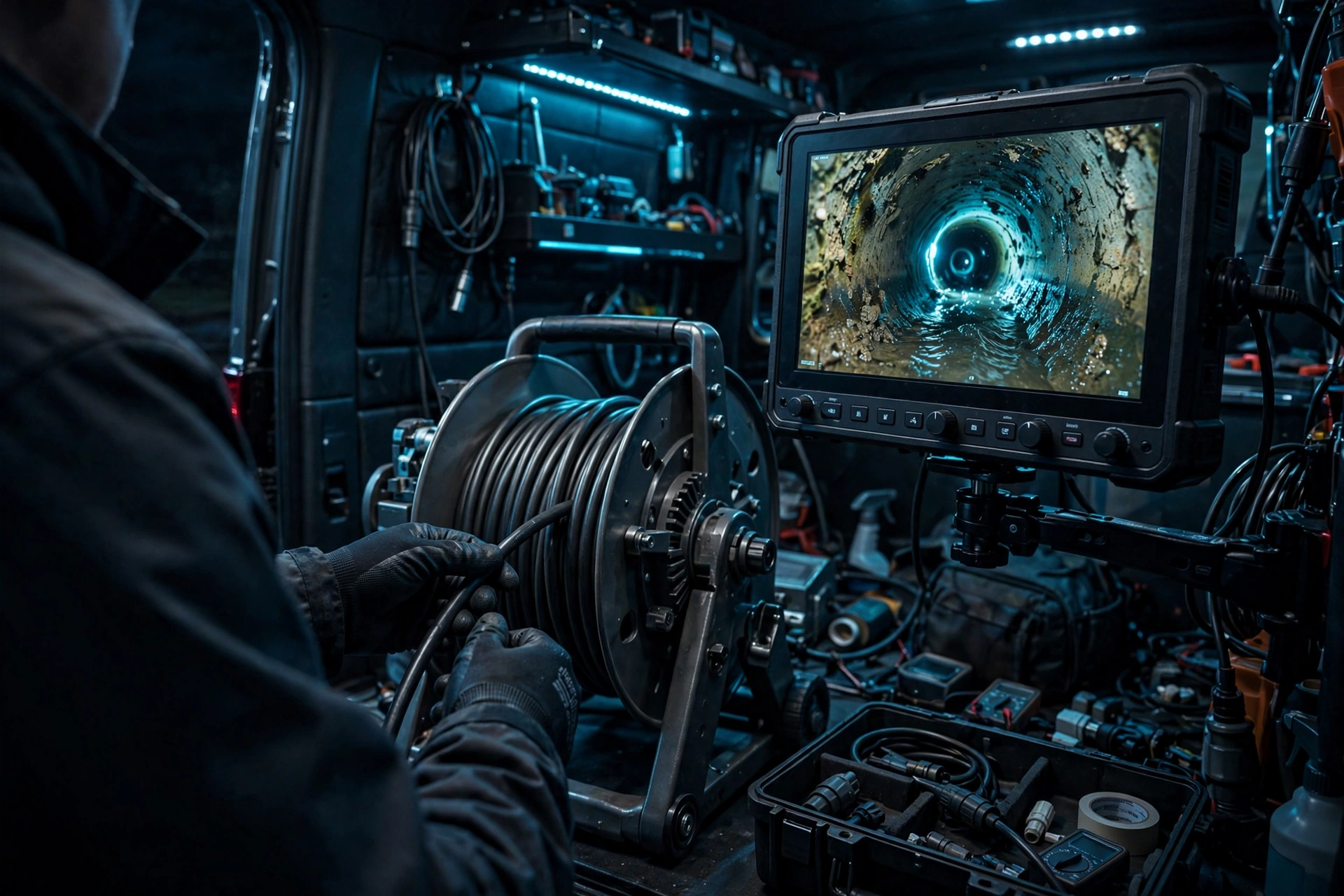
When a sewer or main drain line fails, the symptoms are hard to ignore — repeated backups, drains that gurgle and empty slowly throughout the house, sewage odors in the yard, or suspiciously lush patches of grass over the line's route. But knowing something is wrong with the line and knowing exactly what and where are two very different things, and the difference is worth thousands of dollars: a repair crew that knows the problem is a root intrusion 42 feet out digs one hole, while a crew working blind digs several. A sewer and main drain video inspection — also called a sewer scope, video pipe inspection, or CCTV drain survey — puts a camera inside the pipe and shows us the interior in real time. We use professional fiber-optic push cameras: a flexible rod carrying a self-leveling, high-resolution camera head on a fiber-optic cable, fed through a cleanout or pulled toilet while we watch the live feed on a monitor. The terms you will see — fiber-optic pipeline inspection, pipeline video inspection, sewer camera inspection — all describe this same service, and we use the camera's built-in sonde transmitter with an electronic locator above ground to mark the exact position and depth of anything we find. For Camarillo homeowners, this is the definitive answer to what is happening underground: breaks, root intrusion, bellies, offsets, and buildup, seen with your own eyes on the monitor.
Warning signs
When to call us
Schedule a video inspection when you have recurring drain problems, before buying an older home, or when a plumber recommends excavation for a sewer issue — seeing the actual condition first often shrinks the repair dramatically. It is also the right call when odors or soggy ground suggest a lateral breach but nobody can say where. What a camera inspection is not: a leak-detection method for pressurized water lines — different tools, different physics.
How we find it
Our primary tool: a waterproof, self-leveling camera head on a flexible push rod with a fiber-optic cable, transmitting live high-resolution video to a monitor. We watch the pipe's interior in real time — joints, cracks, roots, standing water — as the camera travels the line.
The camera head carries a sonde that broadcasts a signal through the soil. With an electronic locator above ground, we trace the pipe's route and mark the exact surface position and approximate depth of any defect — so a repair crew digs once, in the right place.
The best entry point is an existing cleanout; without one, we can often pull a toilet for access. We assess access options before we begin and explain any limitations a missing cleanout creates.
The inspection is recorded and the key findings are documented with footage distances — the exact footage marks where each defect sits. You keep the evidence for contractors, buyers, or insurers.
We inspect the main drain line through to the lateral connection and as far into the lateral as access and conditions allow, since problems frequently sit at the transition between the two.
Our process
- 1Access and setup
We locate your cleanout (or arrange toilet-pull access), set up the camera reel and monitor, and confirm the line is safe to scope. - 2Camera traverse
The fiber-optic camera is fed through the line while we watch the live feed, calling out defects, measuring footage distances, and recording everything. - 3Sonde locating
At each significant defect, we activate the sonde and mark its exact surface position and depth with the electronic locator — paint on soil, tape on hardscape. - 4Findings review
We walk you through the footage on the monitor, showing you each problem in plain language: what it is, where it is, and how urgent it looks. - 5Report and recommendations
You receive the recorded video plus a written summary of findings with footage marks and surface locations — everything a repair contractor needs to quote accurately.
A sewer camera inspection is clean, quiet work — the camera goes in through a cleanout or toilet, and the 'digging' happens only on the monitor. Most residential inspections take one to two hours including locating and documentation. You are encouraged to watch the live feed; there is something uniquely convincing about seeing the roots or the break with your own eyes. We do not perform the repair — our job is the diagnosis — but our report is built to make your repair contractor's quote precise.
Honest limitations
A camera shows the pipe's interior condition, not everything about it: heavy standing water or sludge can obscure the lens, a fully collapsed section may stop the camera from passing, and the sonde gives approximate depth that varies with soil conditions. The camera also cannot assess the structural condition of the soil around the pipe or predict exactly when a marginal defect will fail — we describe what we see, grade its severity honestly, and flag what deserves prompt attention versus monitoring. If the line cannot be accessed without excavation, we will say so before charging you for an inspection that cannot be completed.
Camarillo & Ventura County context
Camarillo's older neighborhoods carry the pipe materials of their era — vitrified clay and cast-iron laterals in mid-century homes, with mature landscaping whose roots have had decades to find every joint. Ventura County's expansive clay soil shifts seasonally, stressing rigid pipe joints and creating the offsets and bellies our cameras find routinely. Tree-lined areas like Las Posas Estates are classic root-intrusion territory. One more local fact worth knowing: the Camarillo Sanitary District maintains the public sewer system, but the private lateral from your house to the main is the homeowner's responsibility — which is exactly why scoping your own line matters. With the city council's May 2025 approval of four years of water and sewer rate increases, the cost of every gallon lost or every emergency backup rises too — a camera inspection that prevents one unnecessary excavation pays for itself many times over. For buyers, a pre-purchase scope is especially wise in Old Town Camarillo and the city's older tracts.